Beyond the Classroom: Mentoring the Next Generation
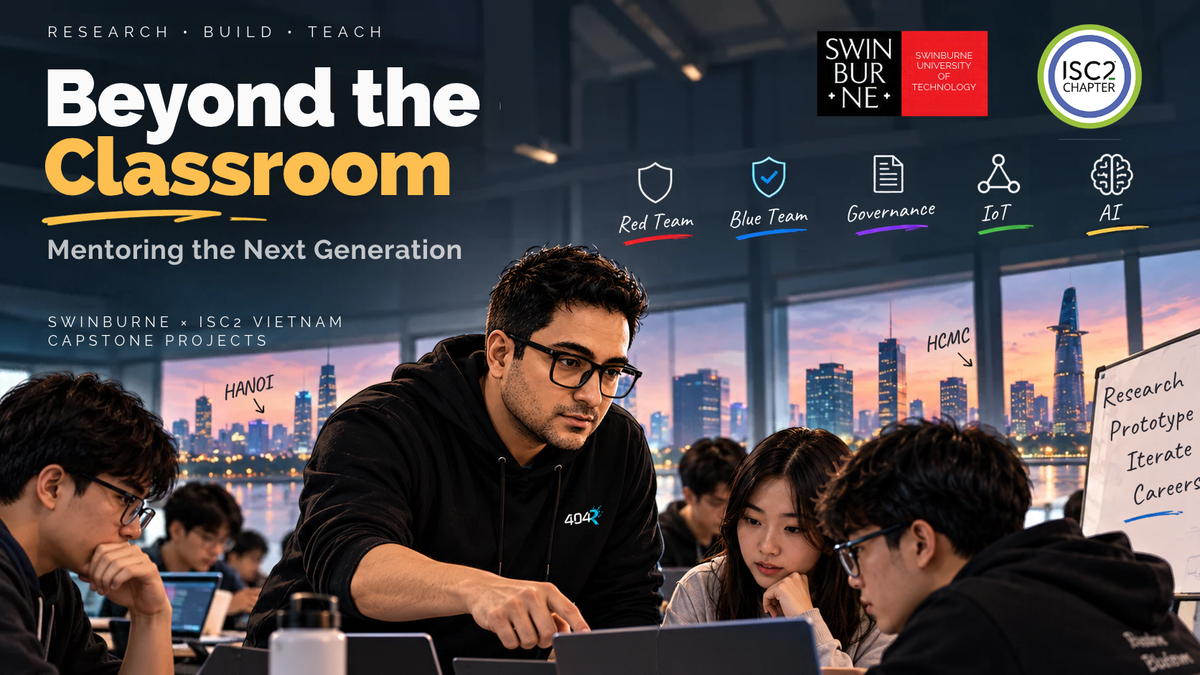
Building practical AI, IoT, and cybersecurity research through Swinburne Vietnam's capstone projects.
Where We Begin
Hey everyone! It's been a little while since we last spoke! I've been quite busy lately, but I'm excited to share something I've been working on!
Recently, I've been collaborating with Swinburne University Vietnam through the ISC2 Vietnam Chapter on a new capstone mentorship initiative.
This year marks our first pilot program, where students have been given several project areas to explore, including red teaming, blue teaming, governance, IoT, and artificial intelligence.
Over the next six months, we'll be working alongside these students as they develop professional research skills, apply technical knowledge, and build functional prototypes.
Our goal is simple: help students bridge the gap between academic learning and real-world industry expectations.
Rather than focusing solely on completing a university assignment, we want students to experience what it means to research a problem, design a solution, develop a prototype, and communicate their findings professionally.
What Is My Role?
I'm currently serving as the Vice President of the ISC2 Vietnam Chapter and representing the chapter in this collaboration.
As part of the initiative, I'm overseeing six teams of five students, approximately 30 students in total, across Swinburne's Hanoi and Ho Chi Minh City campuses.
I meet with the teams both online and in person, helping guide them through the different stages of research, prototyping, and refinement.
Since the program only began in September, we're still in the early stages. However, one team has already completed approximately four weeks of research and is beginning to transition into prototyping!
It's exciting to see their ideas gradually develop into something tangible.
What Have I Learned So Far?
One of the biggest things I've learned is that every team operates differently.
Some groups are relatively independent and require very little assistance, while others benefit from more structured guidance, regular check-ins, and help navigating technical challenges.
Neither approach is necessarily better. Each group has different strengths, experiences, and challenges.
This has been particularly interesting for me because I've spent years mentoring and teaching students individually, but overseeing multiple research teams simultaneously is a different experience.
I've had to adapt how I communicate, manage expectations, and provide feedback depending on each team's situation.
Sometimes that means providing technical direction. Other times, it means helping students organize their research, break down complex problems, or simply figure out their next steps.
I'm learning that effective mentorship isn't about giving everyone the same instructions. It's about understanding where each team is and helping them move forward.
And honestly, I'm enjoying that challenge!
Final Thoughts
I'm incredibly honored to be part of an initiative that helps students prepare for their future careers.
It's rewarding to work with so many talented young people and watch them begin developing the confidence and skills needed to tackle real-world challenges.
This experience has also given me a different perspective on higher education. Having studied in the United States and now working closely with university students in Vietnam, I'm gaining a greater appreciation for the different academic expectations, research approaches, and challenges students encounter.
There's still a long way to go, and we're only at the beginning of this pilot program. I'm looking forward to seeing how these projects develop over the coming months and sharing what we learn along the way.
A big thank you to Swinburne University Vietnam and the ISC2 Vietnam Chapter for the opportunity to contribute to this initiative.
Here's to building, researching, and learning together!